- WhatsApp: 8613777772066
- Email: [email protected]


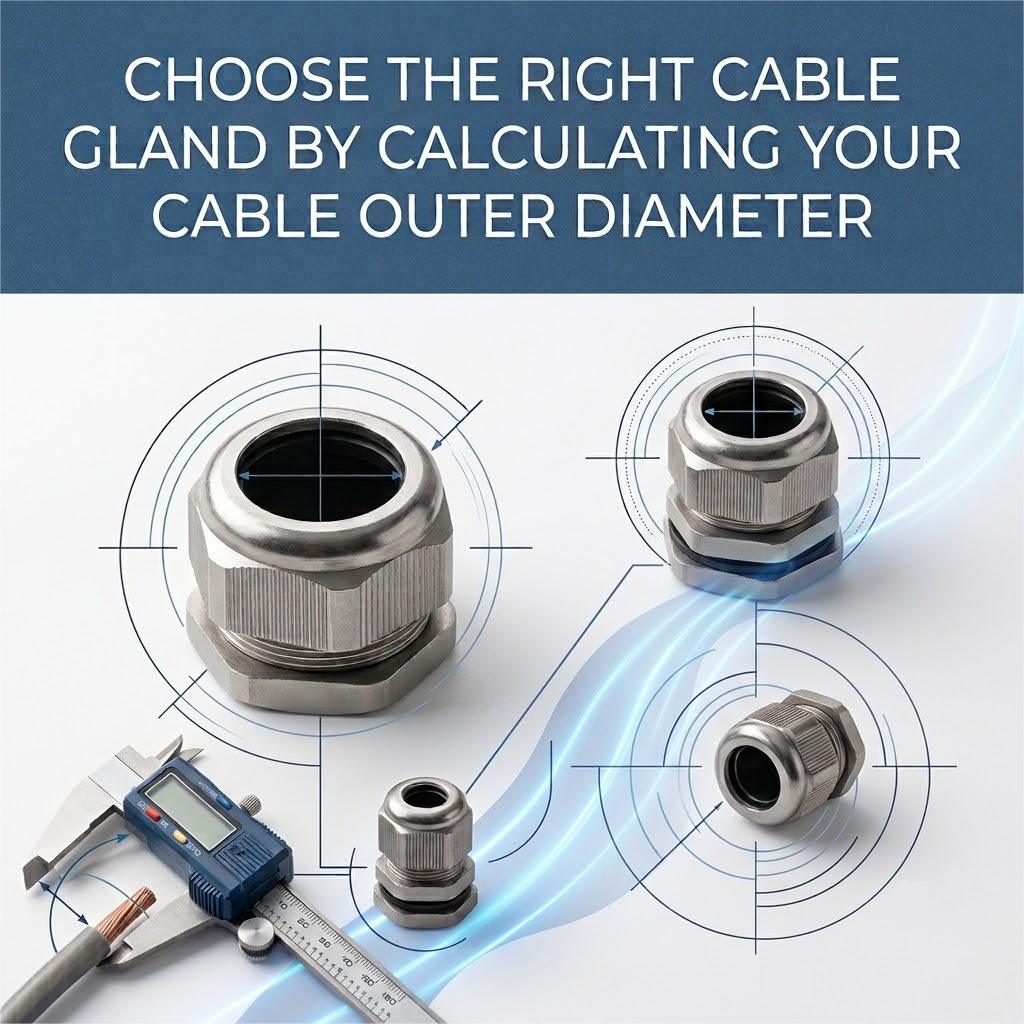
Ordering the wrong cable gland is one of the most common — and most avoidable — mistakes B2B buyers make on a wiring project. It’s rarely a bad product. It’s almost always a mismatch between the cable gland’s clamping range and your cable’s actual outer diameter. Get that one spec wrong, and even a premium gland will leak, fail your IP rating, or damage the cable jacket on install.
This guide shows you exactly how to select the right cable gland size by calculating your cable outer diameter correctly, so your team stops guessing and starts ordering the correct fit the first time.
| Quick answer: To choose the right cable gland, measure your cable’s outer diameter (cable OD) at its widest point, round up to the nearest 0.5 mm, then match that number against a cable gland size chart. Pick the gland whose clamping range holds your cable OD near the middle — not at either edge — for a reliable, leak-free seal. |
Every cable gland your business buys is built around a clamping range, not a single fixed size. That range exists because the internal sealing ring can only compress so far before it stops sealing properly or starts damaging the cable. Choosing the correct cable gland for the job means your cable OD needs to sit comfortably inside that range so the gland can:
If you’re specifying cable glands for a panel build, an OEM assembly line, or a distribution project, cable OD is the first number to lock down — before thread type, before material, before anything else.

You don’t need lab equipment to get a reading that’s accurate enough for correct cable gland selection. A digital or vernier caliper covers almost every application your business will run into. Standardize this process across your team:
Once you have that number, you’re ready to pick the gland size directly off the chart below.
Thread size alone won’t tell you whether a cable gland fits your cable — you need the OD clamping range behind it. Here’s a general cable gland size chart covering common PG and metric cable gland dimensions used across industrial and B2B electrical projects:
| Cable Gland Thread Size | Cable OD Range (mm) | Cable OD Range (in) | Typical Application |
|---|---|---|---|
| PG9 | 4 – 8 mm | 0.16 – 0.31 in | Sensor and control cables |
| PG13.5 | 6 – 12 mm | 0.24 – 0.47 in | Standard multi-core control cable |
| PG16 | 10 – 14 mm | 0.39 – 0.55 in | Motor and junction box entries |
| PG21 | 13 – 18 mm | 0.51 – 0.71 in | Power distribution cable |
| M16 | 4 – 10 mm | 0.16 – 0.39 in | Instrumentation cable |
| M20 | 6 – 12 mm | 0.24 – 0.47 in | General panel wiring |
| M25 | 9 – 17 mm | 0.35 – 0.67 in | Multi-conductor feeder cable |
| M32 | 11 – 21 mm | 0.43 – 0.83 in | Heavy-duty industrial cable |
Figures above are general reference ranges. Always confirm exact cable gland dimensions against the product datasheet before ordering, since clamping ranges can vary slightly by material and manufacturer.
Once you know your cable OD, you still need to pick the correct thread standard and gland style for your enclosure — this is where a lot of B2B orders go wrong, especially when equipment is sourced from different regions. If you’re not sure whether your project calls for PG or metric threading, this comparison of PG vs metric cable gland thread types breaks down exactly when to use each so your order matches your enclosure’s existing knockouts.
The gland style matters just as much as the size. Different installations call for different cable gland types — standard, dome-top, reduced entry, or divided — and picking the wrong style can undo an otherwise perfect OD match.
Material is the third variable. If your business is sourcing for chemical exposure, outdoor installs, or high-volume light-duty runs, nylon cable glands often deliver the best balance of cost and corrosion resistance. For heavy-duty industrial environments that need higher mechanical strength or EMI shielding, metal cable glands are typically the better fit. Browse the full range of cable glands to compare sizes and materials side by side before you place your order.
Multi-core cables add a layer of complexity to cable gland selection, because the outer diameter depends on how many conductors are bundled together and how they’re jacketed. A 2-core cable and a 4-core cable of the same conductor gauge won’t share the same OD, which means they won’t share the same gland size either. If your business regularly specs multi-conductor cable, work from a dedicated 4-core cable gland size chart rather than estimating from single-core figures, since bundled cores typically increase overall OD by 15–30% over an equivalent single-core cable.

You don’t need a complicated formula for cable gland size calculation — you need a consistent process. Use this sequence every time your team specs a new project:
Sitting your cable OD near the middle of the range, rather than right at the minimum or maximum, gives you a buffer for manufacturing tolerance on both the cable and the gland — which matters a lot when you’re ordering in bulk for your business.
| Mistake | Result |
|---|---|
| Measuring only conductor diameter, not the jacket | Gland ordered too small, won’t fit over the cable |
| Sizing the gland to the minimum of the clamping range | No sealing margin; leaks develop over time |
| Sizing the gland to the maximum of the clamping range | Over-compression, jacket damage, cracked seals |
| Ignoring oval or flat cable dimensions | Incomplete seal around the wider axis |
| Assuming PG and metric glands are interchangeable | Cross-threading, or gland won’t seat in the knockout |
| Not sure which cable gland fits your project? BOESE can help you match cable OD to the right size, thread, and material for your business. |
Measure your cable’s outer diameter at its widest point, round up to the nearest 0.5 mm, and match that figure against a cable gland size chart. Choose the gland whose clamping range holds your cable OD near the middle, not at either edge.
Cable outer diameter (cable OD) is the measurement across a cable’s outermost jacket. It’s the key spec behind cable gland selection, because every gland is built around a specific OD clamping range that determines whether it seals properly and holds its IP rating.
Use a digital or vernier caliper to measure across the widest point of the cable jacket. Take three readings at different points along the cable, use the largest value, and round up to the nearest 0.5 mm before checking it against a cable gland size chart.
An undersized gland won’t clamp down enough to seal, leading to water and dust ingress. An oversized gland can crush or deform the cable jacket and still fail to hold its rated IP seal. Both outcomes mean rework and reordering for your team.
Thread size (like PG16 or M20) determines how the gland screws into your enclosure. Cable OD is a separate measurement that determines whether the cable fits inside the gland’s clamping range once it’s installed. You need both to match for a correct fit.
Yes, within a range. Every cable gland has a stated clamping range, not a single fixed size, so it can accommodate some variation in cable OD. The key is staying within that range, ideally near the middle rather than at either edge.
A cable gland size chart lists thread sizes alongside their corresponding OD clamping range in millimeters or inches. Find your measured cable OD, then look for the thread size whose range comfortably contains that number, preferably in the middle third of the range.
PG threading follows an older German standard with its own pitch and diameter conventions, while metric threading (M12, M16, M20, etc.) uses standardized ISO measurements. The two are not directly interchangeable, so your enclosure’s existing knockout standard determines which cable gland your business needs.
Often, yes. Bundling multiple conductors under one jacket increases overall cable OD compared to a single-core cable of the same gauge. Always measure the finished multi-core cable directly rather than estimating the gland size from single-core dimensions.
Choosing the right cable gland isn’t just a sizing exercise — it’s what protects your installation’s IP rating, your equipment’s strain relief, and your team’s time on the line. Standardize the cable OD measurement process above, cross-check it against a reliable cable gland size chart, and you’ll cut down on mis-ordered parts and installation rework across every project your business runs.
| Ready to order the right cable gland the first time? Explore BOESE’s full range and get sizing support for your business. |


Modern enterprise integrating R&D, production, sales and service
Privacy Policy | Sitemap
Copyright BOESE Co.,Ltd SUPPORT BY :JUNJ
 Optimized by Seraphinite Accelerator