- WhatsApp: 8613777772066
- Email: [email protected]


Think of a cable gland thread as the “handshake” between your wire and your machine. If the threads don’t match, the connection fails. Whether you’re sourcing for a new project or maintaining old equipment, understanding different cable gland thread types is the secret to a leak-proof, professional-grade installation that keeps your business running smoothly.

In the world of threaded cable glands, you aren’t just looking at a simple screw. You are dealing with international engineering languages that have evolved over decades. For a buyer or an engineer, grabbing the wrong box of glands isn’t just a minor inconvenience—it’s a project delay waiting to happen.
While there are dozens of niche threading styles used in specific regions, three names dominate the modern B2B market:
Metric Threads: This is the “Type-C” of the industrial world. It’s the modern, global standard that almost every new machine uses. If you are starting a project from scratch, this is likely what you’ll need.
PG Threads: The classic German standard. You’ll find these on legacy European machinery, heavy-duty sensors, and specialized medical or food-processing equipment.
NPT (National Pipe Thread): Primarily seen in North America, these threads are tapered, meaning they get tighter the further you screw them in.
Getting these cable gland thread types mixed up is a nightmare. Imagine your team is on-site, a hundred miles from the warehouse, trying to fit a PG gland into a Metric hole. They might look similar to the naked eye, but they will never create a safe, waterproof seal.
If you walk into any factory built in the last decade, you will see metric cable glands everywhere. But why did the world decide to move in this direction?
The Beauty of Millimeters
Metric threads are incredibly easy to identify. They are always labeled with an “M” followed by a number—like M12, M20, or M63. That number is the exact outer diameter of the thread in millimeters. This simplicity reduces errors in procurement. If your hole measures 20mm, you grab an M20 gland. It’s that intuitive.
The 60-Degree Engineering Advantage
A metric thread cable gland uses a 60-degree thread angle. Why does this matter for your business? This specific geometry provides a massive amount of mechanical strength. When you tighten the nut, the threads bite into each other with high precision, creating a vibration-resistant grip. For industries like automotive or robotics, this means the gland won’t rattle loose over time.
Future-Proofing Your Inventory
As a vendor or wholesaler, stocking metric thread cable glands is the safest investment. Because the ISO Metric standard is the international requirement, these parts are easy to source, easy to replace, and compatible with 90% of new electrical enclosures hitting the market today.
“PG” stands for Stahl-Panzer-Rohr-Gewinde. It’s a mouthful, and it sounds old-school because it is. Originating in Germany, the PG cable gland was the undisputed king of European engineering for over a century.
Why Won’t PG Disappear?
You might wonder why we still talk about PG threads if Metric is the new standard. The answer is “Legacy.” Millions of high-end German and Italian machines are still in operation today, and they all have PG-threaded entry points. If you are a maintenance contractor, you must keep a stock of pg thread cable glands to service these existing systems.
Spotting the Differences
To the untrained eye, a PG16 might look like an M20, but the details tell a different story:
The Angle: PG threads have a shallower 80-degree angle.
The Pitch: The distance between the threads is smaller than Metric. This gives the PG gland a “flatter” appearance on the screw portion.
Sizing Logic: PG sizes (like PG7, PG9, PG21) are based on the internal diameter of the conduit they were originally designed for. This makes them much harder to “guess” without a cable gland size chart. Using a professional reference is the only way to ensure your vendor provides the exact match for your project.
Can you swap them? The short answer is a hard no. Even if two glands appear to be the same size, their internal “DNA” is completely different. Let’s look at why pg vs metric cable glands are not interchangeable.
Thread Pitch: The Invisible Barrier
The “pitch” is the distance from the top of one thread to the next. Metric threads generally have a larger pitch (they are “chunkier”), while PG threads are finer. If you try to force them together, you will cross-thread the connection. Once a metal thread is cross-threaded, it’s permanent—you’ve just turned an expensive enclosure into scrap metal.
Sealing and IP Ratings
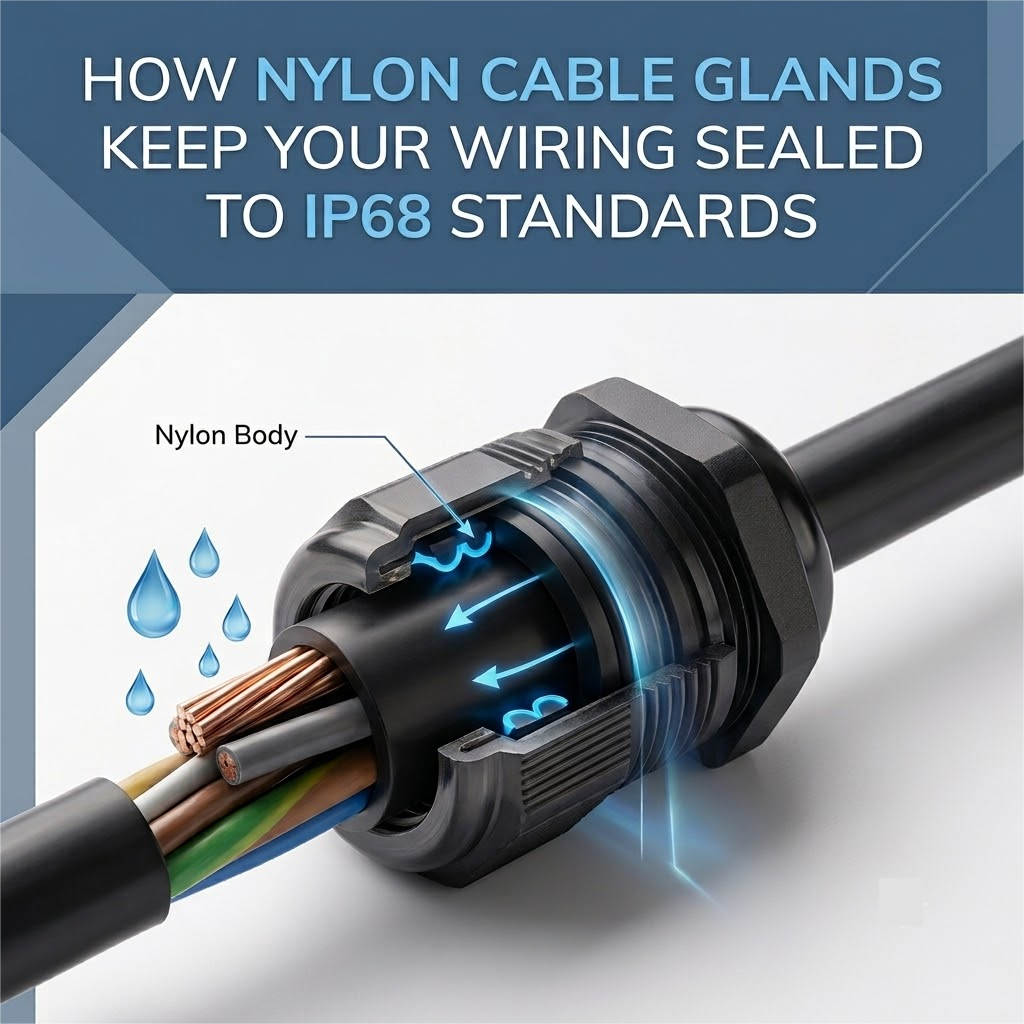
The goal of an electrical cable gland is to keep water out (IP68). A mismatched thread might “feel” tight, but there will be microscopic gaps between the mismatched grooves. Over time, humidity and dust will seep through those gaps, leading to short circuits or “ghost” faults in your control system that are a nightmare to troubleshoot.
Material Behavior
Plastic Cable Glands: In nylon versions, forcing a mismatch will simply strip the plastic. It’s an annoying mistake, but cheap to fix.
Metal Cable Glands: In nickel-plated brass or stainless steel, forcing a fit can generate enough heat to “cold-weld” the two parts together. You won’t be able to get them apart without a hacksaw.
| Feature | Metric Threads (M) | PG Threads (PG) |
| Thread Angle | 60° (Stronger grip) | 80° (Flatter profile) |
| Identification | M + Size in mm (e.g., M20) | PG + Number (e.g., PG13.5) |
| Pitch (Distance) | Coarser (larger gaps) | Finer (smaller gaps) |
| Best For | New projects & global sourcing | Legacy machinery & sensors |
| Common Sizes | M12, M16, M20, M25, M32 | PG7, PG9, PG11, PG16, PG21 |
So, your business just imported a high-end machine from Europe with PG13.5 holes, but your local warehouse only stocks metric threads. You aren’t stuck, but you do need a plan.
The Adapter Solution
Don’t reach for the drill! The most professional way to handle a mismatch is with a cable gland pg to metric conversion adapter. These are small, threaded rings that act as a bridge. They have a male PG thread on one side (to fit the machine) and a female Metric thread on the other (to fit your new gland).
Reading the Conversion Chart
To get this right, you need a reliable cable gland thread conversions chart. For example:
PG7 is roughly similar to M12.
PG13.5 is often the “twin” of M20.
PG21 usually maps to M25.
Note: “Similar” does not mean “Same.” Always use the adapter to maintain the IP68 waterproof rating.
A Vendor‘s Tip for Success
If you are a distributor, always suggest the adapter when a customer is unsure. Selling a $2 adapter alongside a $5 gland prevents a $500 headache for the client. That’s the kind of expert service that keeps businesses coming back to you.
Choosing the right types of cable glands involves more than just picking a standard. You have to ensure the physical fit is perfect.
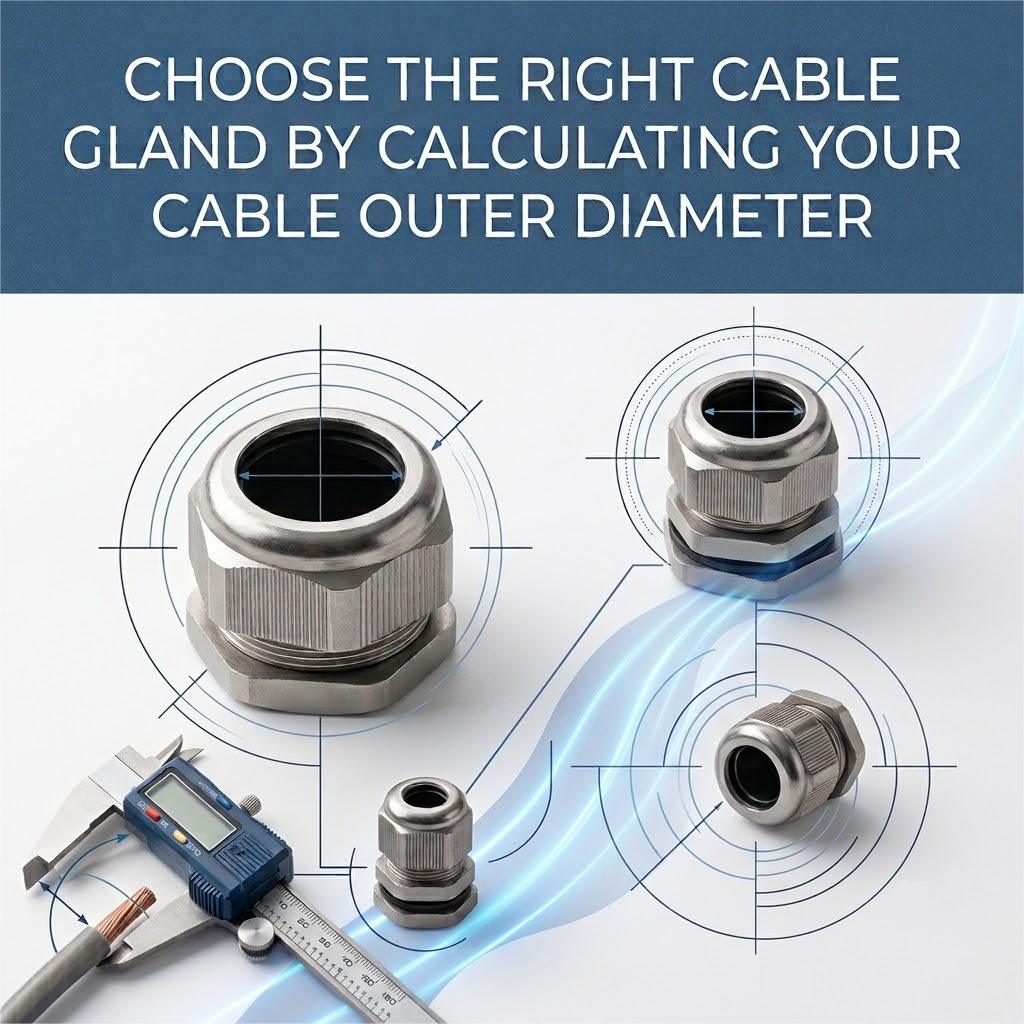
Measure Twice, Order Once: Don’t trust your eyes. Use a digital caliper to measure the outside diameter of the thread. If it measures exactly 20.0mm, it’s an M20. If it measures 20.4mm, it’s likely a PG13.5. That 0.4mm difference is the difference between a perfect seal and a stripped thread.
Account for Wall Thickness: If you are installing into a thick-walled cast aluminum box, make sure you order “Long Thread” glands. Standard threads might be too short to reach the locknut on the other side, leaving you with an insecure connection.
Check the Gasket: Every threaded cable gland relies on its O-ring or flat washer. When switching between thread types, ensure the washer sits flat against the surface. If the thread is too long or the hole is slightly beveled, the gasket won’t compress, and your “waterproof” seal will be useless.
Can I use a PG gland in a Metric hole if I use enough Teflon tape?
Absolutely not. Teflon tape is for plumbing, not electrical safety. It won’t correct the thread pitch mismatch and will eventually leak.
Which is better for new industrial projects: PG or Metric?
Metric is the modern global standard. It’s easier to find parts for, compatible with more new tech, and better for long-term maintenance.
How can I tell a PG thread from a Metric thread just by looking?
Metric threads are usually deeper and more “pronounced.” PG threads appear flatter and have a more subtle slope (80° vs 60°).
What is the most common cable gland pg to metric conversion?
The most common swap is converting a PG13.5 hole to accept an M20 cable gland, as these are the standard sizes for most sensors.
Navigating different cable gland thread types doesn’t have to be a headache. Once you understand the “DNA” of Metric and PG standards, you can make smarter, safer, and more cost-effective decisions for your business. Still unsure which thread fits your project? Contact BOESE today for a professional cable gland size chart and expert technical support!


Modern enterprise integrating R&D, production, sales and service
Privacy Policy | Sitemap
Copyright BOESE Co.,Ltd SUPPORT BY :JUNJ
 Optimized by Seraphinite Accelerator