- WhatsApp: 8613777772066
- Email: [email protected]


Choosing the right nylon cable tie supplier can feel straightforward… until it isn’t. You’re not just buying plastic ties—you’re securing quality, consistency, and long-term reliability for your supply chain. In this guide, you’ll learn how to evaluate suppliers, compare product specifications, and avoid costly sourcing mistakes, especially when sourcing nylon cable ties at scale.
You might think nylon cable ties are simple, low-cost items—but poor quality can quietly damage your reputation. Weak tensile strength, inconsistent locking mechanisms, or substandard nylon materials can lead to failures in real-world applications.
In one case, a European distributor switched suppliers to reduce costs by 8%. Within three months, their clients reported breakages in outdoor installations. The result? Product recalls, delayed projects, and lost trust.
That’s the real cost of choosing the wrong nylon cable tie supplier.

A dependable manufacturer ensures:
When you work with a professional manufacturer like BOESE Electrical Plastic, you’re not just buying products—you’re investing in supply chain stability.
High-quality nylon cable ties are typically made from Nylon 66 (PA66), known for:
Lower-grade suppliers may mix recycled materials, which reduces durability.
Reliable suppliers should provide:
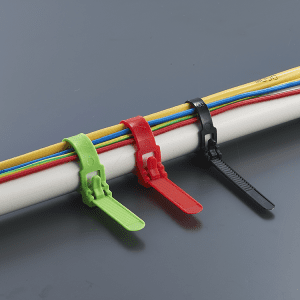
Ask yourself: can your supplier handle large, repeat orders without variation?
A qualified nylon cable tie supplier should offer:
A U.S.-based electrical wholesaler once partnered with a small factory that couldn’t scale production. During peak season, delays extended to 6–8 weeks, forcing them to source emergency stock at higher prices.
Lesson learned: capacity matters just as much as price.
Your supplier should provide a wide range of:
Customization options include:
If you’re targeting different markets—say construction vs. electronics—you’ll need different specifications. A flexible supplier saves you from juggling multiple vendors.

| Length (mm) | Width (mm) | Tensile Strength (kg) | Typical Use Case | Color Options | Material Type |
|---|---|---|---|---|---|
| 100 | 2.5 | 8 | Small electronics wiring | Natural/Black | PA66 |
| 200 | 3.6 | 18 | General cable bundling | Multiple | PA66 |
| 300 | 4.8 | 22 | Industrial applications | Black/UV | PA66 |
| 370 | 7.6 | 55 | Heavy-duty bundling | Black | PA66 |
| 530 | 9.0 | 79 | Large cable management | Black | PA66 |
These are ideal for tight spaces—electronics, small appliances, and PCB wiring. You’ll notice they’re lightweight and easy to install, but not suitable for heavy loads.
This is your all-purpose category. Most buyers rely on these sizes for general cable management across industries. If you’re unsure what to stock, start here.
Used in construction, telecom, and industrial environments. These ties provide higher tensile strength and can bundle thicker cable groups.
Less common but essential for large-scale installations—think infrastructure or heavy machinery. Not all suppliers can produce these reliably.
A cheaper quote might look attractive—but consider:
A slightly higher price from a reliable nylon cable tie supplier often results in lower total cost.
Think in terms of:
In B2B procurement, value beats price every time.
A responsive supplier can:
A Middle Eastern distributor faced customs delays due to missing compliance documents. Their supplier responded within hours and provided the necessary paperwork—saving weeks of delay.
That’s the kind of partner you want.
Choosing the right nylon cable tie supplier isn’t just a procurement decision—it’s a strategic move that affects your entire business. From material quality and certifications to production capacity and communication, every factor plays a role in ensuring you deliver reliable products to your customers.
When you partner with an experienced manufacturer like BOESE Electrical Plastic, you gain more than a supplier—you gain consistency, scalability, and peace of mind.
If you’re looking to source high-quality nylon cable ties with reliable performance and competitive pricing, now is the time to evaluate your current supplier… and make the upgrade.
Nylon 66 (PA66) is the industry standard due to its strength, heat resistance, and durability.
Request certifications like UL, RoHS, and REACH, and ask for product samples for testing.
The 200 mm length with 3.6 mm width is widely used for general applications.
Black ties usually contain UV inhibitors, making them suitable for outdoor use.
Yes, many manufacturers offer logo printing and custom packaging options.
It depends on your application—light-duty for electronics, heavy-duty for industrial use.
High-quality ties can last years, especially if UV-resistant materials are used.
Electrical, construction, automotive, and telecommunications industries.
Check reviews, certifications, and production capabilities before placing large orders.
Fast and clear communication helps resolve issues quickly and ensures smooth operations.

Modern enterprise integrating R&D, production, sales and service
Privacy Policy | Sitemap
Copyright BOESE Co.,Ltd SUPPORT BY :JUNJ
 Optimized by Seraphinite Accelerator