- WhatsApp: 8613777772066
- Email: [email protected]


You can use a cable tie on a CV boot — as a temporary, get-you-home measure. What you cannot do is treat it as the repair. A tie will hold a torn or slipped boot in place for a short run, but it cannot deliver the even, 360° clamping pressure that a dedicated CV boot clamp applies, and on a driven axle that difference decides whether the grease stays where it belongs.
If you run a service fleet, manage a workshop, or buy automotive consumables for distribution, that distinction is not academic. It is the difference between a five-minute roadside stabilisation and a comeback job, a warranty claim, or a customer’s axle failing on the motorway. In this article, we break down exactly when a cable tie earns its place on a CV boot, where it fails, and what your business should keep on the shelf instead.

A CV (constant velocity) boot is the accordion-shaped rubber or thermoplastic cover fitted over the CV joint at each end of your drive shaft. It has one job: keep grease in, and keep water, dirt, and road grit out. Inside that boot, the joint articulates through steering and suspension angles while spinning at road speed — which means the boot flexes thousands of times per minute in an environment that combines brake heat, exhaust heat, and winter road spray.
That is why the fix has to be more than “hold the rubber in place”. Once a boot tears, centrifugal force flings grease out within a few miles, and an abrasive paste forms inside the joint. A repair that costs a boot kit and an hour of labour today becomes a complete axle or joint replacement — and, for your customers, unplanned downtime — if the seal is not restored properly. Whatever holds the boot in place has to survive heat, motion, vibration, and grease chemistry at the same time. Very few things that cost cents can do all four.
You have probably seen it happen: a technician spots a torn boot during a roadside inspection, the correct clamp kit is two hours away, and there is a handful of ties in the van. Wrapping one around the boot gets the vehicle back to the workshop without grease spraying across the underbody. It is cheap, fast, and always in stock — which is exactly why it keeps happening, on every continent.
The problem is that “looks fine on the lift” is not the same as “sealed”. A cable tie can appear to solve the problem in the workshop, then quietly give up at speed and temperature. Understanding precisely where a tie works and where it does not lets you set a clear policy for your technicians — and stops a ten-cent decision from turning into a four-figure failure.
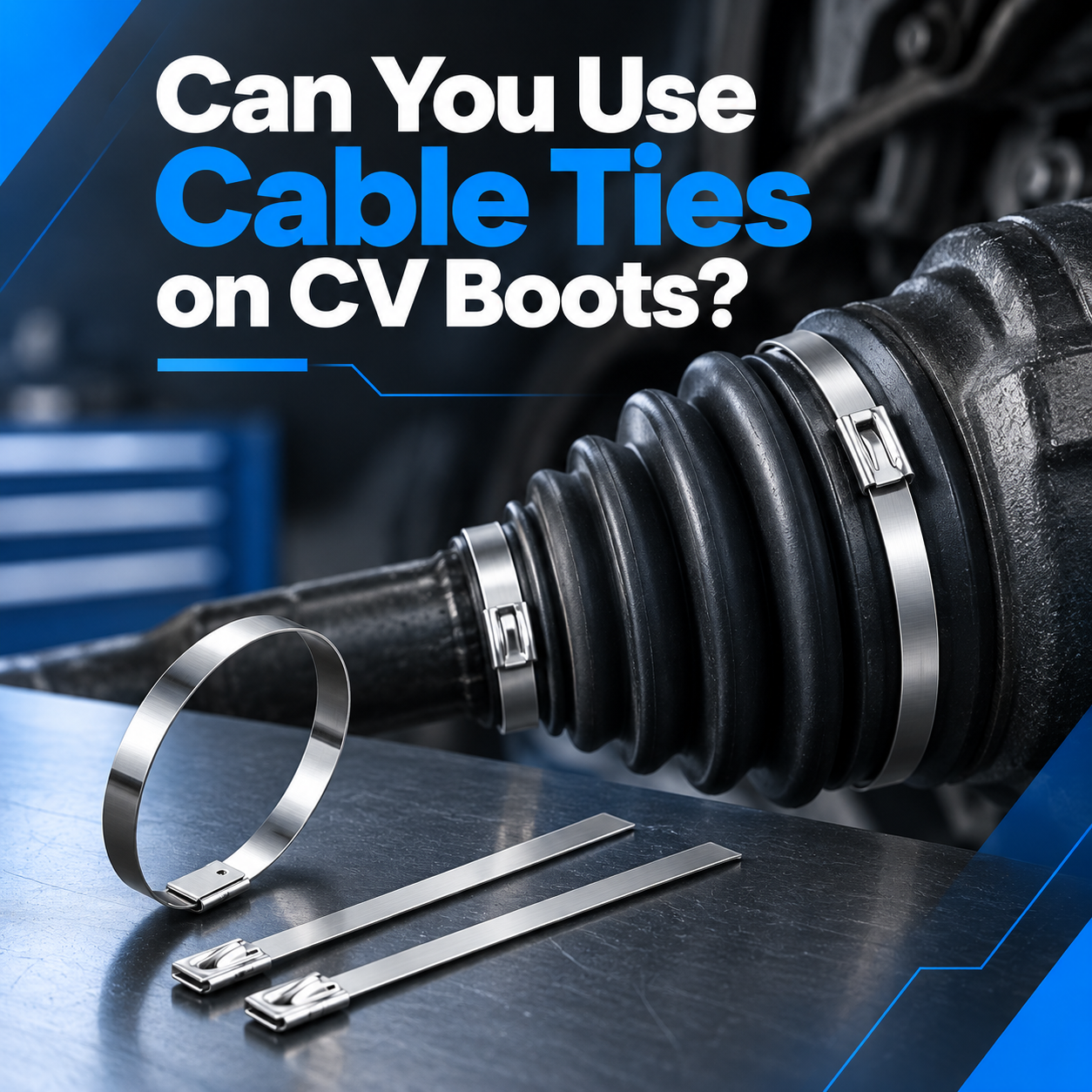
In a genuine emergency, a wide, heavy-duty tie has a legitimate role. If a boot tears on the road, fold or trim the torn rubber flat, wipe away the excess grease, and wrap one wide tie — or two, spaced apart — over the damaged area to slow the grease fling. Then drive gently: moderate speed, no full-lock turns, straight to a workshop. For this job, stainless steel cable ties are the better choice, because they tolerate underbody heat and resist corrosion far better than standard nylon in a greasy, wet environment.
Heat is the first killer. A front CV joint sits close to the brake and exhaust path, and under load the local temperature can climb well past what a general-purpose nylon tie is rated to handle. Standard PA66 ties are typically specified for around +85°C to +105°C of continuous use; even automotive-grade PA66 ties are rated from –40°C up to +130°C. If you prefer to spec ties by temperature zone rather than by price, our guide to zip tie temperature ratings walks through the full picture.
Rotation is the second. Your axle spins at road speed, so the tie head becomes a hard lump taking a beating several thousand times a minute, while the tension underneath it relaxes as the boot flexes. Sealing is the third: a tie compresses a single line around the boot, whereas a proper ear clamp presses evenly around the entire circumference — and grease always finds the path of least resistance. Finally, an over-tightened narrow tie can cut into the rubber itself, converting a repairable boot into a guaranteed replacement.
| What matters | Cable tie (emergency only) | CV boot clamp (the actual repair) |
|---|---|---|
| Sealing pressure | Single compression line; grease can migrate past it | Even 360° pressure on the boot bead |
| Heat resistance | Nylon softens near exhaust and brake heat | Metal band unaffected by underbody temperatures |
| Vibration & rotation | Tension relaxes as the boot flexes; the head takes the beating | Crimped ear stays locked at installation spec |
| Risk to the boot | Narrow edges can cut the rubber when over-tightened | Smooth band designed for the job |
| Service life | Hours to a few days of gentle driving | The remaining life of the boot itself |
| Cost per fix | Cents — but frequently followed by an axle | A few dollars, once |

If your vehicles operate in hot climates, on mountain routes, or under sustained load, spec for temperature from the start instead of discovering it through failures. Nylon 66 (PA66) ties give you a dependable –40°C to +130°C working window, which comfortably covers engine bay and interior work on the same vehicles that carry CV boots. For anything near sustained heat or long-term exposure on the undercarriage, move up to coated stainless. The principle is simple: match the tie material to the zone it lives in, not just to the unit price. That is what separates a parts programme that builds trust with your customers from one that quietly generates complaints and returns.

For the repair itself, nothing replaces a proper CV boot clamp kit and the crimping tool that goes with it — that combination is what actually restores the seal. But a smart shelf goes further than the clamp. Keep a small emergency assortment of wide, heavy-duty automotive cable ties in every service van and every parts package: industrial-strength PA66 ties with loop tensile strengths up to 250 lbs will stabilise a torn boot long enough to get the vehicle home, and they earn their keep every day afterwards on wiring looms, hoses, and sensor cables around the same vehicle.
If you distribute parts, this is also a natural cross-sell. Boot kits, clamps, and a sleeve of self-locking nylon cable ties move together, and the workshop that finds the right tie already in the box remembers the supplier who thought of it. For undercarriage and hot-zone applications, round the range out with stainless options. Our article on why automotive-grade cable ties are worth specifying covers what separates a true automotive tie from a repackaged household one — material purity, temperature rating, and consistent tensile strength.
| Need Cable Ties for Your Market? BOESE manufactures PA66 nylon and stainless steel cable ties for automotive distributors, fleets, and workshops. |
Print the card below and pin it to the toolboard, or tuck it into your parts catalogue. It condenses this entire article into the four decisions your team actually faces on the floor — and one rule of thumb that keeps everyone honest.
| CV Boot Fix Selector — print it and pin it to the toolboard | ||
|---|---|---|
| Your situation | Do this now | Reach for |
| Boot torn on the road, vehicle must move today | Trim the tear flat, wrap 1–2 wide ties over it, drive gently straight to the workshop | Wide stainless steel cable ties |
| Boot intact but slipped off the joint | Reseat the boot and fit a proper clamp — no tie substitutes here | CV boot clamp + ear-clamp tool |
| Permanent repair | Replace the boot, torque the clamps to spec, re-pack with grease | Boot kit + clamp kit |
| Daily bundling on the same vehicles | Engine bay looms, hoses, sensors, interior trims | Automotive-grade PA66 nylon ties |
Rule of thumb: a cable tie buys you time; a clamp buys you mileage.
You can use one as a temporary measure to get a vehicle to a workshop, but you should not use one as the repair. A zip tie compresses a single line around the boot and cannot maintain even circumferential pressure while the axle spins, flexes, and heats up. Proper CV boot clamps cost only a few dollars, so there is rarely a business case for accepting the risk of a joint failure that can run to hundreds of times more.
Treat it as hours to a few days of gentle driving — not weeks, and not motorway speeds. Tension relaxes as the boot flexes, heat softens the nylon, and once grease starts migrating the countdown to joint damage is already running. If a customer’s vehicle arrives with a tie already wrapped around the boot, quote the boot replacement, not just a re-clamp: the joint has usually already lost enough grease to be at risk.
Use the widest heavy-duty tie you can find, preferably stainless steel for heat and corrosion resistance; a PA66 automotive tie is acceptable for a short hop in cool conditions. Avoid thin general-purpose ties — they either snap under load or cut into the rubber — and never stack several cheap ties as a substitute for one correctly tensioned clamp.
It can. An over-tightened narrow tie cuts into the rubber under constant flex and vibration, and the groove it leaves behind often becomes the point where the boot tears next. Grease chemistry matters too: prolonged contact with petroleum grease can degrade some nylon formulations, which is another reason the fix should stay temporary and the boot should be inspected properly once the vehicle is back inside.
Generally no. Larger-diameter boots need proportionally more clamping force to seal, and a standard tie cannot develop enough circumferential pressure across that span. A long, wide tie may work as a limp-home measure on light commercial vehicles, but for truck and agricultural fleets the correct clamps should be stocked as a line item — the cost of one failed joint dwarfs the clamp many times over.
Source from a manufacturer that controls its own material and certification. Look for 100% virgin PA66 rather than recycled blends, ISO 9001 production, RoHS compliance, and product-level certification such as TUV and CE, plus OEM sizes, colours, and export packaging.
| Put the Right Tie in Every Box From emergency stainless ties to engine-bay PA66 workhorses, BOESE builds automotive cable ties that hold their rating in the real world. Tell us your market and volumes — we respond within one business day. |


Modern enterprise integrating R&D, production, sales and service
Privacy Policy | Sitemap
Copyright BOESE Co.,Ltd SUPPORT BY :JUNJ
 Optimized by Seraphinite Accelerator