- WhatsApp: 8613777772066
- Email: [email protected]


When a cable gland fails, the first sign is rarely a puddle you can see. It’s more often corrosion inside a junction box, a nuisance trip, or downtime you can’t explain until you open the enclosure. If your equipment runs outdoors, underground, in washdown areas, or anywhere exposed to moisture, the small fitting at the cable entry point is doing more work than most specifications give it credit for. Nylon cable glands are one of the most widely used components in that seal — and also one of the most misunderstood. This article walks you through exactly how nylon cable glands achieve an IP68 waterproof rating, what separates a genuine watertight cable gland from one that only sounds like one, and how to choose the right nylon cable glands for your next project.
IP68 is not a marketing label — it’s a classification defined under IEC 60529, the international standard for enclosure protection ratings. The two digits tell you two separate things. The first digit (6) means complete protection against dust ingress, with no particles entering the enclosure under vacuum-assisted test conditions. The second digit (8) means the component is protected against continuous immersion in water beyond 1 meter, at a depth and duration that the manufacturer defines and discloses.

That last point matters for your procurement decisions. IP68 is not a single fixed test — suppliers specify their own immersion depth and time within the “beyond 1m” tier. When you’re sourcing ip68 cable glands for a project with real submersion or heavy washdown exposure, you should always ask your supplier for the exact depth and duration behind their IP68 waterproof rating, not just the rating itself.
| Rating | Dust Protection | Water Test | Typical Use Case |
|---|---|---|---|
| IP66 | Full protection against dust | Powerful water jets from any direction | Outdoor panels, washdown areas |
| IP67 | Full protection against dust | Temporary immersion up to 1m, 30 minutes | Occasional flooding, low-lying enclosures |
| IP68 | Full protection against dust | Continuous immersion beyond 1m (depth/time set by manufacturer) | Submersible pumps, underground wiring, marine equipment |
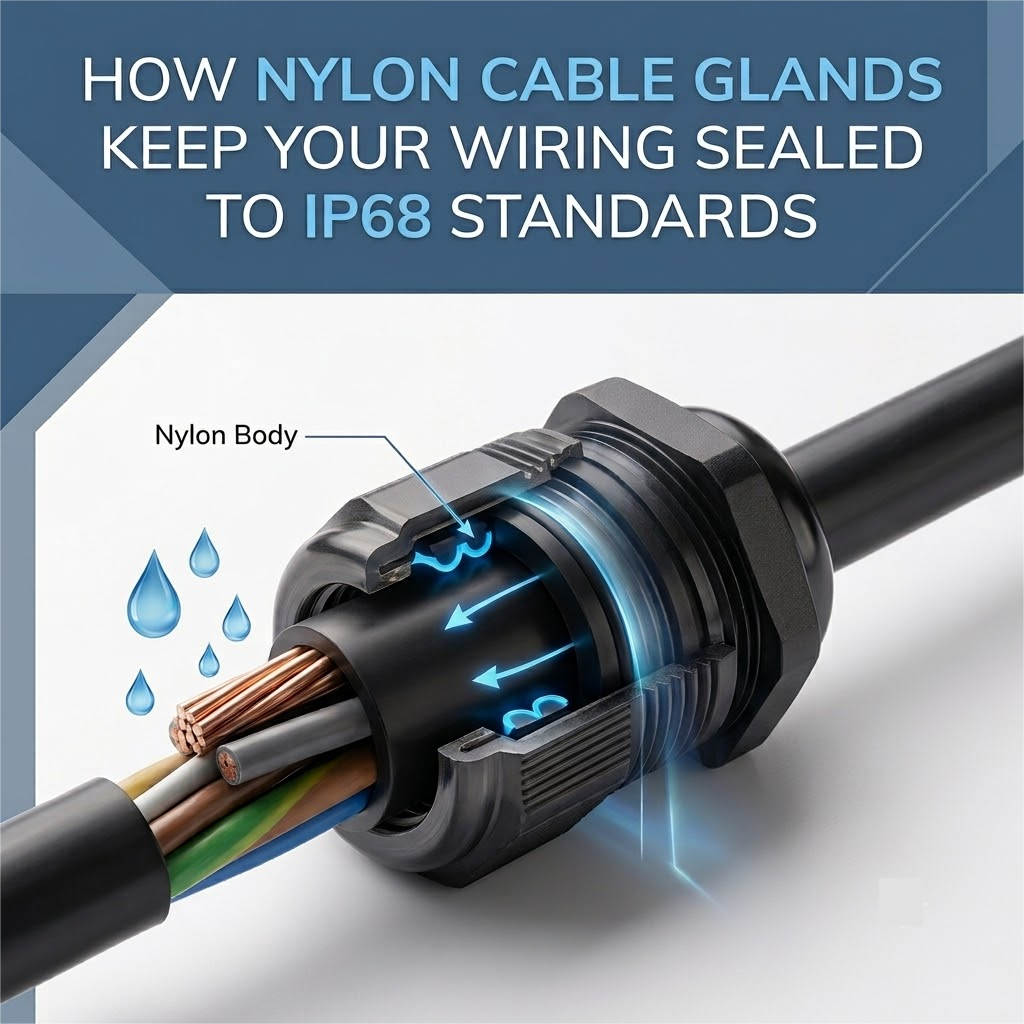
A watertight cable gland doesn’t rely on a single barrier — it’s built from two coordinated seal points, and understanding both helps you evaluate whether a product is actually engineered for the rating it claims.
The primary seal sits between the cable jacket and the gland body. Inside the gland, an elastomer sealing ring (typically EPDM or NBR) surrounds the cable. When you tighten the dome nut, it compresses this ring radially and axially around the cable jacket, closing off any gap where water could track in along the cable surface.
The secondary seal sits between the gland body and the panel or enclosure wall, usually through a flat gasket or O-ring compressed as the gland is torqued into its threaded entry. Both seals have to hold simultaneously for the assembly to meet an IP68 waterproof rating — a gland that only seals well at the cable but leaks at the panel interface will still fail an immersion test.
The nylon body itself isn’t the sealing element — the elastomer is. But the nylon housing has to hold its shape and clamping force under that compression without creeping, cracking, or deforming over time, which is where material selection becomes just as important as the seal design.
Polyamide (nylon 66) is the standard housing material for watertight cable gland construction across most industrial and commercial applications, and for good reason:
You can review BOESE’s full nylon cable glands range, or browse the full range of cable glands if your project also calls for metal options.
An IP68-rated gland only performs to that rating when it’s matched correctly to your cable and application. Three specification points matter most:
1. Thread type. Your gland’s thread has to match the tapped hole in your enclosure — metric (M12, M20, M25, etc.) and PG threads are not interchangeable, and forcing the wrong thread type is one of the fastest ways to break a seal before the gland is even fully installed. If you’re unsure which your equipment uses, this comparison of PG vs metric cable gland threads walks through how to identify and select the correct one for your business.
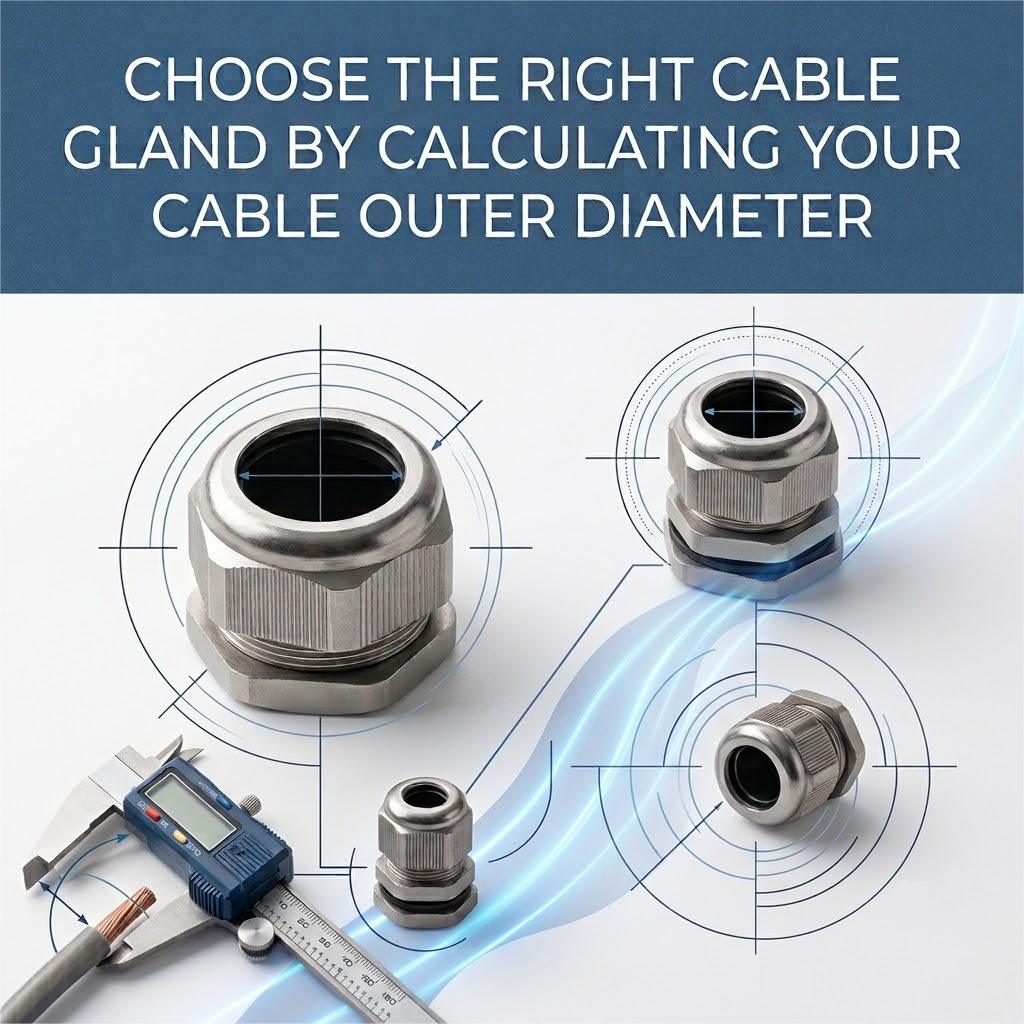
2. Cable outer diameter. Every nylon cable gland has a defined clamping range, and the cable has to fall within that range for the elastomer seal to compress evenly. Too loose, and the seal can’t close the gap; too tight, and you risk deforming the cable jacket or the seal itself. Before ordering, it’s worth taking a few minutes to calculate your cable outer diameter so the gland you order actually fits.
3. Core count and cable type. Multi-core cables, flat cables, and round single cables all seal differently, and gland sizing shifts accordingly. If your project involves multi-conductor cable, this cable gland size chart is a useful reference for matching gland size to core configuration.
Getting these three details right before you order is the single biggest factor in whether your installed glands actually hold an IP68 waterproof rating in the field.

Even a correctly specified nylon cable gland can underperform if it’s installed incorrectly. A few practices protect the rating you’re paying for:
Sourcing nylon cable glands for a project that needs a genuine IP68 waterproof seal? BOESE manufactures nylon cable glands in metric and PG thread types, built for your business’s production and field requirements.
IP68 means the gland provides complete protection against dust ingress and is rated for continuous immersion in water beyond 1 meter, at a depth and duration set by the manufacturer’s own testing.
Yes. Waterproofing comes from the internal elastomer seal design, not the housing material. A well-engineered nylon cable gland can achieve the same IP68 waterproof rating as a metal equivalent for most industrial and commercial applications.
Standard nylon can degrade under prolonged UV exposure. If your installation is permanently outdoors, ask your supplier for UV-stabilized nylon cable glands to maintain long-term mechanical performance and seal integrity.
There’s no single industry-wide maximum — IP68 only specifies “beyond 1 meter,” and manufacturers publish their own tested depth and duration. Always request the specific figures from your supplier for applications with real submersion risk.
Ask for the manufacturer’s test report or certification showing the specific IEC 60529 test conditions used, including immersion depth and time. A supplier that can’t produce this documentation likely hasn’t independently verified the rating.
Typically no, provided the thread type matches the enclosure and the gland is torqued correctly. Some installers add thread sealant on the panel-side thread for extra insurance in high-vibration or extreme-exposure environments.
It varies by gland size, generally spanning a few millimeters within each size designation. Always check the specific clamping range for the gland size you’re considering rather than assuming based on thread size alone.
It’s not recommended for IP68 applications. The elastomer seal takes a compression set around the original cable, and reinstalling with a different cable — or even the same cable — often can’t reliably reproduce the original seal.
PG threads follow an older German standard with a different pitch and diameter system than metric (ISO) threads. They are not interchangeable, and using the wrong type on an enclosure will prevent the gland from seating and sealing correctly.
For critical or continuously submerged applications, an annual visual inspection is a reasonable baseline. Replace any gland showing cracking, seal hardening, or loss of clamping force rather than waiting for a visible leak.


Modern enterprise integrating R&D, production, sales and service
Privacy Policy | Sitemap
Copyright BOESE Co.,Ltd SUPPORT BY :JUNJ
 Optimized by Seraphinite Accelerator