- WhatsApp: 8613777772066
- Email: [email protected]


Leaving jagged, razor-sharp tails on your wire bundles introduces hidden laceration hazards to your assembly lines. Accidentally nicking live insulated wires during routine equipment maintenance can trigger sudden factory blackouts. This guide teaches your technical staff how to cut cable ties safely, select the right extraction gear, and protect your long-term infrastructure investments.
Trimming a fastener tail seems like a simple task, but doing it improperly spoils the presentation of a professional control panel. Your technicians must treat cutting cable ties as a critical finishing step rather than a quick afterthought.
The Problem with Standard Tools: Most field workers pull a standard construction knife or a pair of household utility scissors from their pockets when finishing a wire bundle. These tools crush and stretch the plastic tail rather than slicing it square, leaving behind a sharp, pointed plastic barb.
The Geometry of a Clean Cut: To achieve a professional finish, the cutting blade must sit perfectly square against the smooth face of the locking head. If your team is handling high-density assemblies, reviewing the foundational procedures on how to install cable ties correctly a step by step guide will help them master pre-tensioning habits before making the final cut.
Preserving the Lock Integrity: Slicing the strap at a strange, angled slope can accidentally weaken the internal ratcheting pawl hidden inside the locking head. A straight, perpendicular slice ensures the remaining strap maintains its full rated loop holding power under heavy physical loads.
To consistently achieve high-quality results across thousands of electrical connections, your business needs to move away from generic shop tools and invest in a dedicated cable tie cutter tool.
Engineered for Polymers: Unlike general utility knives, a dedicated cable tie trimmer is built with specialized jaw geometry specifically optimized to bite through dense industrial plastics like Nylon 66 without slipping.
Ergonomic Spring Mechanisms: These tools feature integrated return springs and non-slip handles designed to reduce hand fatigue during long shifts, allowing assembly workers to make hundreds of repetitive cuts smoothly.
Precision Jaw Alignment: The blades are calibrated to close with exact parallelism, ensuring that the plastic strap is sheared cleanly in a single squeeze rather than being gnawed or frayed by mismatched cutting edges.
The finish of your cable tie installation directly impacts workplace safety and system reliability. Slicing the tail perfectly level with the locking head is a critical requirement for several operational reasons.
Eliminating Workplace Injuries: When field engineers reach deep into packed electrical boxes to trace a fault, protruding plastic spikes can easily slice through skin. Safety managers mandate using cable tie flush cutters because removing these sharp points is the easiest way to prevent painful arm lacerations on the factory floor.
Preventing Structural Snags: In high-density server racks or aircraft wire looms, loose data lines are constantly pulled through the system during upgrades. Protruding tie tails catch on passing wire jackets, causing insulation tears or stretching delicate fiber optic lines out of alignment.
Professional Inspection Compliance: Quality control auditors use flush cuts as a visual benchmark for workmanship. Clean, flat finishes signal that an electrical assembly has been put together with high-standard, professional-grade tooling.
Field teams working on remote cell towers, outdoor solar farms, or emergency utility repairs frequently run into situations where their primary tool kits are out of reach. Learning how to cut a zip tie without scissors keeps your field operations moving forward without compromising safety.
Utilizing Precision Micro-Nippers: Small electronic side-cutters make an excellent substitute for standard scissors. Their tiny, pointed jaws slide easily into tight spaces, letting technicians snip away excess plastic material without disturbing nearby delicate copper connections.
The Controlled Friction Technique: If you are dealing with a thick, heavy-duty plastic tie and lack cutting tools, applying concentrated friction can work in a pinch. Technicians can use a tough, textured wire or a small pocket saw blade to carefully friction-saw through the strap backing away from the live wire bundle.
The Clean Snap Method: For low-profile, light-duty utility ties, grabbing the loose tail firmly with a pair of needle-nose pliers and twisting it 90 degrees back and forth rapidly will cause the polymer to cold-work and snap off right at the head, leaving a relatively smooth finish.
Tooling Blueprint: Selecting the Right Cutter for Your Fastener Inventory
| Tool Designation | Ideal Material Match | Cutting Mechanism | Core B2B Application |
| Precision Micro-Snips | Standard Nylon 66 (18-50 lbs) | Bypass shear blades | Delicate IT server rack wiring, PCB board assemblies |
| Industrial Flush Cutters | Thick Weatherproof Nylon (50-120 lbs) | Zero-clearance anvil jaw | Commercial solar racking, industrial panel building |
| Mechanical Tension Gun | Heavy Nylon & Polymer Straps | Automated pull-and-shear blade | Automotive assembly lines, high-volume manufacturing |
| Hardened Steel Plier Shear | Bare & Coated Stainless Steel | High-leverage bypass dies | Offshore oil rigs, heavy chemical processing networks |
Standard plastic snips will instantly dent, chip, or ruin their cutting edges if they face rigid steel straps. When your facility transitions to heavy-duty metal bands, your safety protocols and tooling options must upgrade accordingly.
The Challenge of Tough Steel: Learning how to cut metal zip ties made of high-tensile 304 or 316 stainless steel requires tools capable of handling extreme material hardness. Standard diagonal pliers will simply bend the steel band, creating dangerous, jagged metallic burrs.
Using a Dedicated Cable Ties Cutter: Specialized steel-cutting pliers utilize induction-hardened bypass blades to shear through tough metal bands cleanly. The tool holds the metal strap firmly in place during the cut, preventing the severed tail from snapping back violently toward the technician’s eyes.
Shielding the Underlying Insulation: Unlike soft plastic, a sharp steel edge can slice through rubber power cable insulation like a razor. Hardened plier cutters feature a smooth, rounded safety guard on the bottom jaw that keeps the sharp metal blades raised safely away from the underlying wire jackets during the cutting stroke.

If your factory workers manually tension and snip hundreds of ties every single day, relying on basic hand pliers slows down production and introduces human error. Automating this workflow keeps your lines moving efficiently.
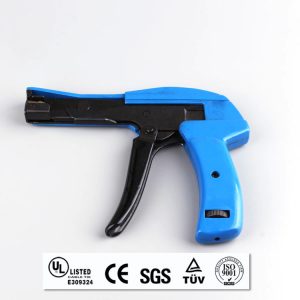
Guaranteed Tension Uniformity: A professional cable tie gun plier cutting system completely eliminates guesswork. The operator simply sets a specific tension limit on the tool’s dial, squeezes the trigger, and the mechanical gun pulls the strap to that exact limit every single time.
Automated Flush Trimming: The moment the pre-set tension limit is reached, the gun’s internal hidden anvil blade instantly fires. It clips the excess strap perfectly flush against the locking head in one smooth movement, saving your workers from switching between two different hand tools.
Slashed Labor Overhead: Manually pulling and clipping plastic bands triggers repetitive wrist strain injuries (RSI) over time, driving up your worker compensation claims. Implementing automatic tensioning guns speeds up assembly times by 40% while protecting your staff from physical fatigue.
When system engineers need to modify circuit networks, replace bad sensors, or add new data lines to an existing bundle, extracting old ties safely is just as important as installing new ones.
The Danger of Utility Knives: Slashing at a tight tie wrap with a standard box cutter or pocket knife is a major recipe for a catastrophic short circuit. One tiny slip of the hand will slice open the expensive copper conductors underneath, triggering immediate system downtime.
The Anatomy of a Safe Extractor: A professional cable tie removal tool utilizes a unique, specialized safety jaw design. The bottom tip features a flat, blunt guard shoe that slides smoothly underneath the locked strap, gently lifting the plastic loop up and away from the delicate wires before the upper blade cuts the band.
Preserving Your Copper Investments: Using a proper extraction tool guarantees that your maintenance teams can slice away heavy bundling straps in seconds without leaving a single nick, scratch, or scrape on your high-value fiber optic jackets or heavy power feeds.
Why should my company buy specialized flush cutters instead of standard diagonal side cutters?
Standard side cutters leave sharp, wedge-shaped plastic peaks that slice technicians’ skin; flush cutters shear the strap perfectly level and flat.
What is the fastest cable ties cutter system for high-volume automotive wire harness manufacturing?
An automatic, tension-calibrated cable tie gun speeds up production lines and guarantees uniform, automated cut quality across every single bundle.
How to cut metal zip ties safely if our technicians don’t have a steel tension gun on site?
High-leverage hardened steel plier shears or heavy aviation snips can cut the bands, provided technicians wear thick safety glasses.
Can a professional cable tie removal tool be reused across different plastic and metal band widths?
Most removal tools handle all standard plastic widths, but heavy stainless steel bands require hardened steel jaws to avoid blade denting.
Is it possible to undo and remove a heavy-duty industrial tie wrap without cutting it away?
Standard ties must be cut, but specialized releasable ties feature an integrated trigger lever to slide the tail out cleanly.
What happens if our assembly staff leaves long tails hanging off our outdoor solar racking ties?
Long tails catch heavy winds, causing continuous physical flapping that stresses the locking head and leads to early plastic fatigue.
Can a standard plastic flush cutter tool be used to trim thin copper grounding wires?
No. Trimming copper wires with a precision plastic flush cutter will immediately dent the delicate jaws, ruining its flush-cutting alignment.
Are automatic cable tie guns compatible with both stainless steel and nylon fasteners?
No. Nylon ties use lightweight polymer guns, while stainless steel bands require heavy steel tension guns with specialized cutoff blades.
Equipping your assembly lines with premium cable tie flush cutters and safe extraction tools protects your technicians from painful injuries while safeguarding live electrical wiring. Sourcing high-grade installation hardware ensures total operational safety compliance. Contact BOESE today to receive direct factory-direct wholesale quotes on your bulk industrial tool orders!

Modern enterprise integrating R&D, production, sales and service
Privacy Policy | Sitemap
Copyright BOESE Co.,Ltd SUPPORT BY :JUNJ
 Optimized by Seraphinite Accelerator